What air system components lose the most pressure?
Looking for critical pressure drop in a compressed air system can be like looking for a needle in a haystack. When important compressed air powered tools or tools or machines are starved for pressure, often the only option is to jack up the compressor settings. The higher the compressor discharge pressure, the more power an air compressor consumes, costing higher energy costs. A compressor will consume about one percent more power for every two psi of higher pressure (around 100 psi).
Often the main distribution piping between the air compressors and the end use gets the blame, but this is not typically where the largest pressure drop occurs. Surprisingly, of all the locations within the system, the biggest pressure loss usually happens in "the dirty thirty", the last 30 feet of supply piping.
To find out if this is true make an assessment of the pressure loss at some of your plant end uses yourself by making up an inexpensive test device. Use a "T" connection with a gauge attached, with male and female quick connect couplings to which you can attached your air tool (this T must be properly sized). This device can give you an idea of the pressure drop characteristics at the far end of your compressed air supply system, and may uncover some problems.
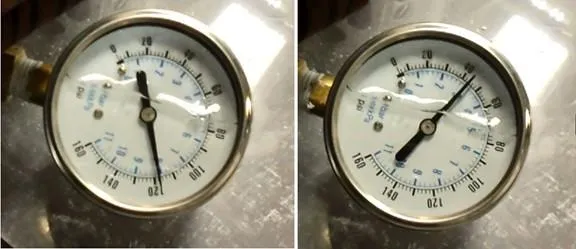
Attach an air tool and measure the pressure with no air flowing, this is the static value. Then operate your device and see the new pressure, this is often a very surprising test. In the previous photograph, the difference in pressure between static and dynamic flow tests is 73 psi. The pressure fell to a low of 44 psi, since the tool is actually rated at 90 psi the performance of the attached tool was very poor and was causing production delays.
The source of the problem was undersized supply hose and an excessive number of quick connect couplers, these were not rated high enough to supply the full flow of the tool. When upgrading the components use the manufacturer's pressure differential ratings and the rated flow of the tool to size the components for less than 10 percent pressure drop at the full tool flow, preferably lower.
A second common location of pressure differential is within the compressor room. The filters, air dryers and even components within the compressor itself can rob the plant of adequate pressure. A simple check can be done to give you a hint of the problem within your compressor room. Attach an accurate gauge to the piping at the discharge of your compressor. If the compressor is operating in load/unload mode, record the highest and lowest pressure. Then move the gauge to a location close to the exit of the supply pipe from the compressor room. Record the highest and lower pressure again. Compare the different readings to find your pressure loss. Best practices would have less than 5 percent pressure loss at this location.
Gaining a lower pressure differential within the compressor room often requires component upgrades and oversizing. Maintenance of main filters is also important. For example, a filter that is sized exactly the same size as the compressor might have a 5 psi pressure loss over the life of the filter element. A second filter might add another 3 to 5 psi of pressure drop. Using mist eliminator style filters, or oversizing might drop the total pressure loss to less than 2 psi. The same relationship works with air dryers, the pressure loss across components varies exponentially, so often larger dryer will reduce the total pressure loss in the compressor room (and provide more dryer capacity during worst case scenarios). Newer air dryers are coming out with lower pressure drops due to optimum designs, and these should be considered when the dryer needs replacing.
Of course the main supply piping should also be considered. This piping should be well sized to ensure less than two percent pressure loss across the whole system. Using looped networks and newer style materials with smooth internals like stainless steel, copper or aluminum can reduce friction and overall pressure loss.